






Seoul A to Z City Guide
Dear reader,
For Aesop, bathing is less a ritual, more a prerequisite for good living—and an opportunity for poetry. We seek poetry in its various places, from store design to artistic collaborations, but most importantly in the creation of formulations that enhance potentially mundane moments in the bathtub, under the shower or at the basin.
One of the most notable examples of such a poetic approach to bathing can be found throughout South Korea. Sesshin is a rigorous (to say the least) exfoliation administered by Ajummas—middle-aged women who pummel, scour and cover bathers in hot towels.
Korean culture has long set sophisticated rules around cleansing, hospitality and personal maintenance. This was shaped by Confucian ideas of presentation and care, as much as by practical domestic knowledge passed between generations.
Aesop’s first Seoul store opened in Garosu-gil in 2013, though the city had occupied our imagination well before then through its architecture, publishing culture, and remarkable ability to refresh its skin without completely shedding older forms of life. May this guide stir your thoughts and senses.
With warm wishes,
The Sensorialist

A to Z list
A
Arts & Science, Daikanyama
A philosophy disguised as a shop.
14-1 Hachiyama-cho Shibuya-ku Tokyo 150-0035
B
Browse ‘Kitchen Town’
Eight hundred metres of cooking supplies. Begin at Kama-Asa Shōten.
2 Chome-24-1 Matsugaya, Taito City, Tokyo 111-0036
C
Cow Books
Left-leaning in spirit, right on taste—paperback manifestos for thoughtful radicals.
1-14-11 Aobadai, Meguro-ku, Tokyo 153-0042
D
Dream House
Drift away from the city and into a world of reverie at Marina Abramović’s singular space.
942-1432 643 Yumoto, Matsunoyama, Tokamachi-city
E
Enoura Observatory
Hiroshi Sugimoto’s coastal opus—a transformative daytrip. For another artistic expedition, travel Shinkansen-speed to Chichu museum, Naoshima.
F
G
Gotokuji Temple
Temple of beckoning cats, rows upon rows of porcelain optimism waving eternity into being.
2-24-7 Gotokuji, Setagaya-ku, Tokyo 154-0021
H
Harukor Restaurant
Ainu cooking and craft.
1-10-1 Hyakunin-cho Shinjuku Tokyo 169-0073
I
Incense Ceremony (Kōdō)
A sister to traditional tea ceremonies, during which one ‘listens’ to scent. Events are occasionally hosted at Japan House.
J
Jazz Bars
Shake a leg, solo or with an ensemble, to any or all of these: Jazz Spot Intro, Hello Dolly, or Bar Martha.
K
Kazuo Ohno Studio
Home of the Butoh pioneer.
1 Chome-20-15 Kamihoshikawa, Hodogaya Ward, Yokohama (short train from Tokyo)
L
Latte as art over Latte art, at Koffee Mameya
Precision brewing.
4-15-3 Jingumae, Shibuya-ku, Tokyo 150-0001
M
Meiji Jingu Shrine
A forest at the city’s heart.
1-1 Yoyogikamizonocho, Shibuya-ku, Tokyo 151-8557
N
Nayoung Kim
South Korea has produced an extraordinary number of internationally recognised dancers, owing partly to rigorous arts education systems and a thriving performance culture. Korean-born Nayoung Kim began her dancing with venerated choreographer Pina Bausch and Tanztheater in 1996, and still performs with her inimitable elegance and grace. Aesop devotees may recall her choreography for the launch of Eleos Nourishing Body Cleanser.
O
Ondol
Supsok Hanbang Land bathhouse draws upon the Korean invention of ondol: underfloor heating that transforms stone and tile into surfaces of rest. Here, in one of just a few houses that still employ charcoal kilns, visitors may take a steam bath among them, or use them to grill sweet potatoes and rice cakes.
P
Artment.dep
A creative studio that has spawned a store, led by creative wonder woman Mijae Kim.
Q
Quartet
Founded in Seoul yet shaped equally by European jazz traditions and Korean musical sensibilities, the Near East Quartet reflects the international orientation of South Korea’s contemporary cultural scene. Begin with their recordings on ECM Records.
R
Respite
Books, a bedroom and a bath for one’s feet. The perfect accommodation for a swift trip in the city, or those in need of inspiration for their next masterpiece.
S
Aesop Seongsu
An Aesop space distinguished by South Korean responsible design practices and other environmentally mindful features: robust glazing, bicycle parking outside the entrance, a rainwater re-use system, oh—and Aesop products.
T
Tea
Supped at Delphic: Grecian name, South Korean origin. Exceptional tea and the corresponding paraphernalia.
U
Upcycling
Designer, collaborator on the Aesop Kyklos project, and new imaginer of the phrase ‘wasted opportunities’, Jisun Kim transforms discarded plastics into functional objects. This sounds like something one might find on some digital marketplace for enterprising makers, but the results would be far more at home inside a design museum.
V
Vinyl House
Vinyl House is a song composed by Mowg for the phycological thriller 버닝 Burning by Lee Chang-dong. The film, regarded by some critics as one of the best of the 21st century, is based on the short story The Elephant Vanishes by Haruki Murakami. The score, present, yet never carrying the image or script, revolves around a bouncing guitar motif that rises and unfurls ambiguously.
W
Women’s Clinic
Kim Chung-up’s buildings introduced a softer and more sculptural interpretation of modernism into a rapidly rebuilding nation. Dr Seo’s Women’s Clinic remains notable for combining concrete monumentality with sensitivity to light and circulation. Discover this and other concrete ideas in the tome Brutalist Korea.
X
Exhibitions
Designed by architect and national treasure Kim Swoo-geun, the Arario Museum endures as a preeminent architectural and cultural touchstone of the city. Those in need of repose should visit the Room of Quiet Contemplation at the National Musem of Korea: a balm to the senses. And if you tend to measure weight by words, visit the Yun Dong-ju Literature Museum, dedicated to one of the country’s most cherished scribes.
Y
Yesteryear
Kim Jung Mi’s 1973 album Now has been on repeat in Aesop stores and offices since we first heard it. Begin with Haenim, featured on this playlist of ours.
Z
Zelkova Tree
The zelkova tree appears throughout Seoul with such quiet regularity that one eventually begins to read the city through its canopy. One of the finest examples of it is over 600 years old, located at the Hwaseong Haenggung Palace in Suwon.
The city through the senses
Listen
Seoul is one of the few cities where eating has its own soundtrack. Not the chef’s Spotify playlist—and hopefully not tourists bawling Black Pink over barbecue smoke—but actual percussion: heavy metal, you could call it.
Korean utensils, known collectively as sujeo, differ from those of neighbouring China and Japan through their use of metal. Brass and silver were historically associated with durability, hygiene and social status, particularly during the Joseon dynasty. The long-standing belief that silver could detect poison through tarnishing ensured its popularity within royal households, though most ordinary families used brass before eventually transitioning to stainless steel in the twentieth century.
If you are in need, Hanssem Flagship Store offers something closer in spirit to Manufactum than a lifestyle boutique. Alongside furniture and domestic goods, one can find well-made Korean tableware. For second-hand examples, try the markets around Dongmyo and Dapsimni.
Taste
The international understanding of Korean food still tends to oscillate between two poles: the theatrics of Korean barbecue, and fried chicken. Korean Buddhist cuisine, by contrast, asks not how much flavour can be added, nor how much batter or beer for that matter, but how clearly a single ingredient can express itself.
Few people articulate this more elegantly than Jeong Kwan, the Buddhist nun whose cooking at Baekyangsa Temple became internationally recognised through an episode of Chef’s Table. Her approach to food is inseparable from Korean Buddhist philosophy: ingredients are fermented because they preserve seasons naturally and deepen flavour; vegetables are treated according to their texture, temperature and water content; while excessive garlic, onion and chilli are generally avoided, as they can overstimulate. A simple temple preparation that can be recreated almost anywhere is braised lotus root. It demonstrates the elegance of Korean Buddhist cooking without requiring specialist equipment or impossible ingredients. Method:
Peel and slice lotus root thinly before soaking briefly in water to remove excess starch. Simmer gently in a mixture of soy sauce, water and a small amount of rice syrup until the slices become translucent while still retaining slight resistance at the centre. Allow the liquid to reduce slowly and finish with toasted sesame seeds.
Smell
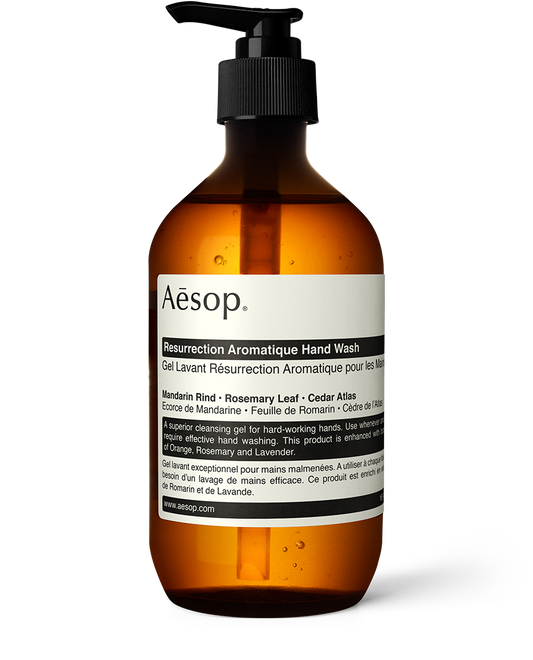
Follow your nose via Seoul’s Aesop stores, distilled as an Eau de Parfum.
Top note: Aesop Sounds Hannam, a modern dwelling in a fresh neighbourhood.
Heart note: Aesop Seongsu, where Aesop’s design philosophy and Korean culture harmonise.
Base note: Aesop Garosu-gil, the neighbourhood where we first brought our amber bottles to Korea.
Touch
Dapsimni Antique Market spreads across numerous streets and warehouses in eastern Seoul. The district specialises in objects that have survived Korea’s transformation into a contemporary technological economy. Here, one can find Joseon-era cabinets beside analogue radios, dinted brass bowls beside lacquer furniture, inkstones next to obsolete telephones, and enamel signage from the 1970s. Three places worth seeking out include Hakgojae Antique, which specialises in scholar furniture; Yesarang for ceramics; and Manbokdang for almost anything else.
See
Historically, Korean culture often removed layers until what remained felt inevitable. One sees it in traditional hanoks, pre-K-pop gayageum music, and in the disciplined restraint of Dansaekhwa painting, which is less ‘minimalist’—in the fashionable Western sense—than ‘essentialist’. Philip Glass, who famously despised the word ‘minimalism’ when used to describe his music, understood something similar: nature—and human nature—itself does not decorate unnecessarily. Artist, writer and philosopher Lee Ufan lives this, describing his work as ‘the art of encounter’. If you are in town, here are three locations to be encountered:
At Ho-Am Museum of Art, one can experience Silentium, the artist’s permanent installation integrated into the landscape surrounding the museum. The temptation may be to photograph it immediately, though the work improves considerably when looked at for longer than contemporary attention spans generally allow. Closer to the city, at Leeum Museum of Art, Ufan’s paintings possess the quiet confidence of leaving space unused. And then there is ‘Space Lee Ufan’ at Busan Museum of Art, which functions less as an exhibition than as a spiritual overhaul.
Essentials for Seoul


Recommended reading
-

The Aesop Women's Library
one-minute read -

Introducing the fragrant fables
three-minute readA new chapterIntroducing the fragrant fables
-

A guide to fragrance
nine-minute readLesson from the labA guide to fragrance


